This week, Senators Mike Lee, Dick Durbin and others proposed the SAFE Act, which the Senate Committee on the Judiciary describes as “Bipartisan legislation [that] would protect Americans from foreign threats and from warrantless government surveillance.”

Whether the continuation of programs pursuant to Section 702 of FISA in any form would provide Americans significant protection from foreign threats is open to debate. What is not open to debate is that, at least as currently authorized, Section 702 of FISA is a blatant violation of Americans’ rights under the Fourth Amendment. In particular, the warrantless collection, storage, and querying of Americans’ communications pursuant to this program is premised on the so-called “third-party doctrine,” which was recently called into question in Carpenter v. United States. Further, careful examination of that doctrine’s history shows that our Supreme Court took a wrong turn in the infamous 1970s cases, Smith and Miller. This historical understanding calls into question the entire edifice upon which all government warrantless surveillance programs have been built in the decades since.
In a nutshell, I believe the SAFE Act:
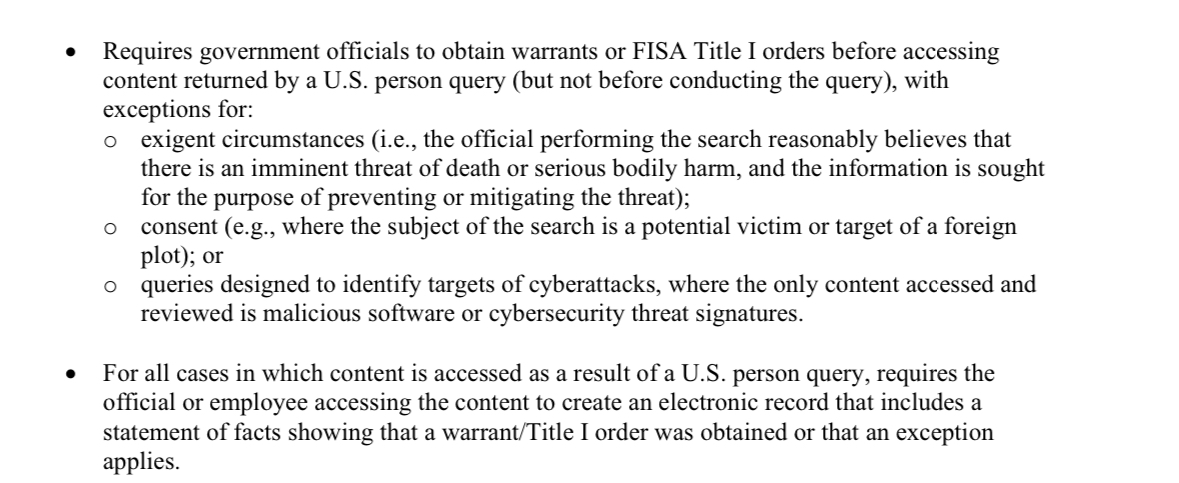
1. Fails to restore the full Fourth Amendment protections that all Americans, in justice, deserve. Not only would it permit the warrantless collection and storage of Americans’ communications to continue unabated, but the warrant requirement for queries would come in to play only after a query returned a positive result. Here’s an excerpt from the section-by-section summary provided by the Senate Committee on the Judiciary:
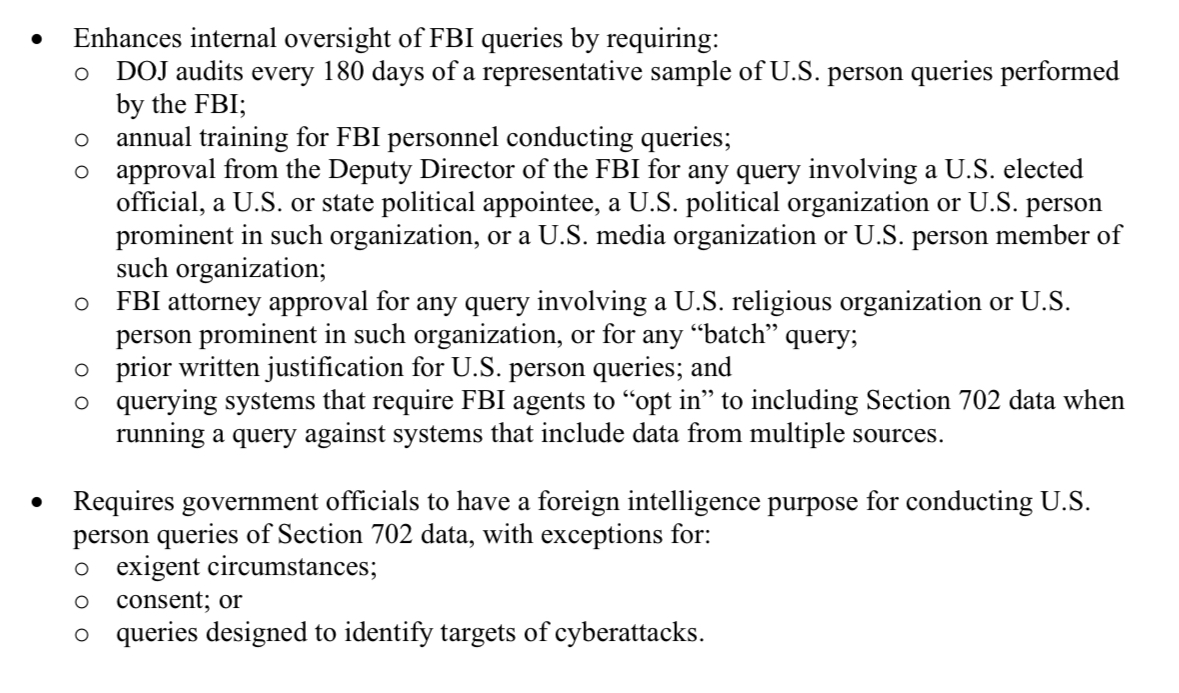
2. May in fact be worse than the status quo, because it would implement a hierarchy of protections whereby those in politics and the media would get the highest level of protection from abusive database queries, followed by those involved in religious groups, with the average “US Person” receiving only the barest level of additional protection. I believe that, if anything, our elected officials should expect to have less privacy than the average American, because they work for us. And yet the SAFE Act would create a heightened level of protection for them. Here’s the relevant excerpt:
Moreover, as Matthew Guariglia and Andrew Crocker over at EFF have pointed out:
Unfortunately, the SAFE Act contains at least one truly nasty addition to current law: an entirely new crime that makes it a felony to disclose “the existence of an application” for foreign intelligence surveillance or any of the application’s contents. In addition to explicitly adding to the existing penalties in the Espionage Act—itself highly controversial— this new provision seems aimed at discouraging leaks by increasing the potential sentence to eight years in prison. There is no requirement that prosecutors show that the disclosure harmed national security, nor any consideration of the public interest. Under the present climate, there’s simply no reason to give prosecutors even more tools like this one to punish whistleblowers who are seen as going through improper channels.
https://www.eff.org/deeplinks/2024/03/safe-act-two-steps-forward-one-step-back
3. Finally, the SAFE Act does not go far enough in addressing the unconstitutional practice known as the “data broker loophole,” under which our government uses tax dollars to purchase private information about us from data brokers. By codifying and not fully closing this “loophole,” the SAFE Act may inadvertently legitimize the very sort of practice that Congress should be prohibiting. No one using his Starbucks card (or similar) believes he is consenting to Bentham’s Panopticon.
Accordingly, at a minimum, I would like to see an amendment to the SAFE Act, or a separate legislative proposal, addressing the above concerns.
In particular, I would suggest an amendment or bill that:
1. Instituted a blanket warrant requirement to collect, store, or query communications of any US Person. (A FISA Title I order would be an acceptable alternative for a warrant insofar as it requires involvement in some form of illegal activity.) Equality before the law regardless of profession or religious affiliation, and full restoration of Americans’ Fourth Amendment rights.
2. Closed the “data broker loophole” entirely by requiring government to obtain either consent from the subject of inquiry or investigation, or a warrant based on probable cause and particularized suspicion, before obtaining any non-public data about Americans.
(Traditional warrant requirement exceptions would apply to both of the above.)
3. Ensured that no new avenues are created for punishing whistleblowers. There is every reason to believe that, even with the addition of new safeguards, the abuses will continue. We deserve to know about them, and those who expose them deserve rewards, not punishments.
So far, with the exception of the EFF, the reception for the SAFE Act has been generally positive. Some seem to think this compromise bill is about the best we can expect in today’s political climate. But I can’t help but wonder whether the special protections the Act affords to the political class, media organizations, and religious organizations, are designed to get buy-in from those who could help influence the bill’s passage.
Your thoughts?