In today’s digital age, headlines scream about “disinformation” as a pervasive menace imperiling the very foundations of our constitutional republic. It’s a term that’s often used to justify restrictions on speech, sometimes sincerely (but mistakenly) for the noble cause of safeguarding truth, but more often for the venal purpose of consolidating power.
During our tenure at Parler we witnessed firsthand the consequences of wielding this term too broadly: we believe Parler was unjustly scapegoated and deplatformed precisely because we refused to “fact-check” content in accordance with the wishes of “trusted partners.” After that experience, we came to realize that it’s not disinformation we should be wary of so much as the lengths to which some will go to maintain control over the narrative. …
Later today The Federalist Society is premiering a short film/documentary on the “third-party doctrine,” something many of you have heard me talk about before. It’s the doctrine which gives a veneer of legality to all the bulk surveillance programs that were revealed by Edward Snowden over 10 years ago. Here’s the cute promotional poster they made for the occasion:
Soon after Snowden’s revelations, I published an article proposing a solution, based in the common law of contract, for this decades-old problem. I am so pleased and honored to have been included in this project, especially because it means more exposure for a theory which could make warrantless bulk surveillance the quaint relic it should be.
Check out the documentary here:
And for those who have watched it, and have wound up here for the first time, welcome! If you’re looking for the law review article explaining my little theory in full, you can find it and download it for free here.
Finally, if you’re not a subscriber already, I encourage you to do so now. (Top of right-hand column.) Soon I will post information on how to pre-order my book, Legalizing Privacy: Why and How, in which I place this little theory of mine in the broader context of the nature of privacy, the value of privacy, and an overall model for its proper legal protection. (And other cool things, too, assuming you value not only your privacy, but also your right to free expression.)
Thanks again for checking out the documentary! If you enjoyed it, could you spare an additional moment and help spread the word about it?
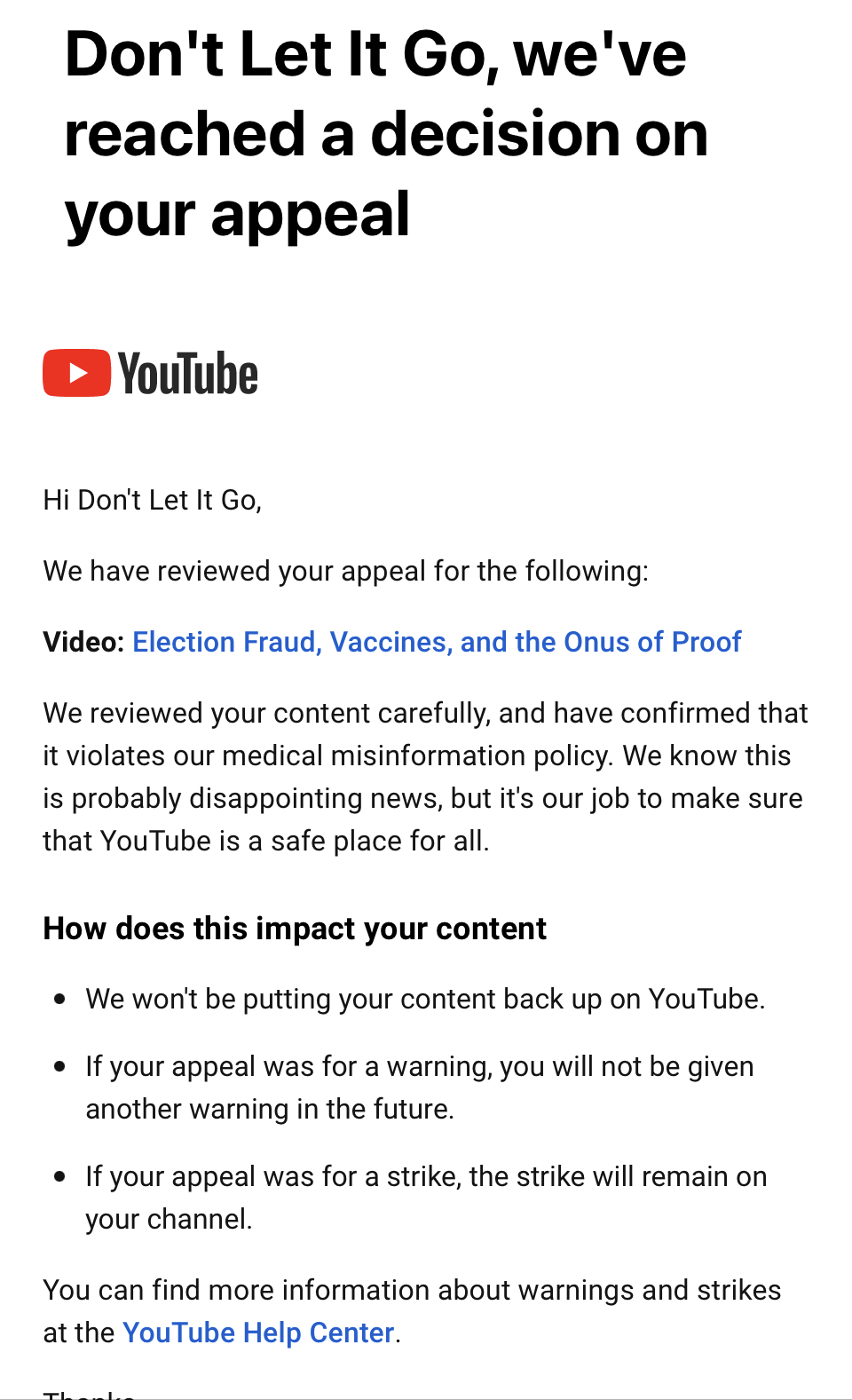
I woke up on Monday to a love letter from YouTube, which reads in relevant part:
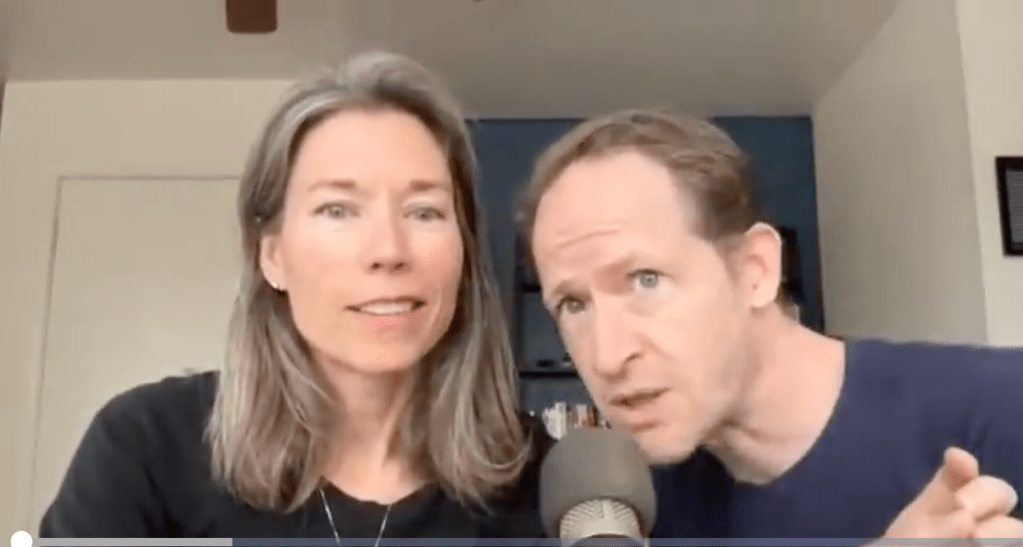
What was the content? A somewhat geeky episode in which Benjamin and I explored the epistemological implications of an analogy between a specific aspect of the Dominion v. Fox News defamation case, and an accusation commonly leveled at COVID-19 mRNA “vaccine skeptics.” Apparently, during the course of this long-form discussion on the contextual nature of the onus of proof, Benjamin or I shared Super Dangerous Medical Misinformation. Watch it if you dare on BitChute:
Given the delay between the time of broadcast (Saturday afternoon), and the time the content was removed (in the wee hours of Monday morning), I suspected this was the result of a report by a disgruntled viewer, and was hopeful an appeal would do the trick. After all, we weren’t telling people to drink bleach or anything. So I appealed and asked in the comment that, should they decide not to reinstate my content, to please let me know what violated their policy against “medical misinformation that contradicts local health authorities’ or the World Health Organization’s (WHO) medical information about COVID-19.”
About 1-1/2 hours later I received their verdict:
They “reviewed the content carefully” in that brief timeframe? Sure they did. And note they provided no indication of what exactly we said during that hour-long episode which violated their government-dictate-based policy. Suppose you thought that you would like to make sure you didn’t violate their policy again. You would want to know what it was that you said, of all the things you said during an hour, that earned you that strike. Good luck! YouTube would rather keep you guessing, keep you self-censoring, to help them better perform their role as government censors-by-proxy, squelching any and all dissent from the approved narratives.
“Now Amy,” you say, “isn’t YouTube a private company? And doesn’t Section 230 protect YouTube’s right to remove whatever content it believes, in good faith, is ‘objectionable’? Certainly you’re wrong in calling it ‘censorship.’”
No, I’m not wrong. First, note that YouTube’s explicitly stated policy is to use government proclamations as a standard for what content is permitted on their platform. Moreover, if you’ve been even casually following developments on this front in the past few years, you have seen numerous hearanguings by Congress, with politicians berating tech CEOs about removing more and more “objectionable” content, upon threat of amending or repealing Section 230, as well as antitrust prosecutions. You are probably also aware of the “Twitter Files,” which have revealed substantial pressure exerted by federal government agencies to remove content or ban accounts from Twitter. Finally, you probably saw when Jen Psaki announced that the Biden Administration had flagged various pieces of “misinformation” for removal by Facebook? I would and am betting that the same sorts of pressures are being brough to bear on YouTube, even if we may never see the “YouTube Files” that, in justice, we so richly deserve. While there are a number of reasons for removing objectionable content which could constitute “good faith,” helping politicians and government bureaucrats do an end run around the First Amendment is not one of them.
Thankfully there are platforms like BitChute which do not censor “misinformation.” Platforms which refuse to be the arbiters of truth, whether the discussion is about medicine and health, climate science, or Hunter Biden’s laptop. Platforms whose policies reflect the fact that science is never settled, and that robust, open discussion, welcoming all viewpoints, is necessary to solve problems and promote human flourishing. Platforms which expect you to think for yourself, rather than outsource your critical thinking to others.
Although YouTube would not allow me to appeal my “strike” further up the labyrinthian hierarchy of government lackeys that they call a Policy Department, they did allow me to say whether I found their email, pronouncing the verdict on my appeal, helpful. I said that I did not, and added the following: “The appeal was processed so quickly, I don’t believe the content was reviewed carefully. Moreover, you have not told me what specifically, of all the things we said in an hour, violated your policy. How do you expect anyone to try posting interesting, thought-provoking content under these conditions?”




 Don't Let It Go