In this comment to this post, a commenter named Daniel pointed out that “isolationism” is an invalid concept. (See here.)
I had forgotten that reference, so thanks to Daniel for mentioning it. When writing that blog post I considered using the term Ron Paul uses, “non-interventionism.” But that term seems to me not to encompass some of his important foreign policy positions — e.g., his objection to the use of trade embargoes or sanctions, as well as his objection to aiding an ally in a way that falls short of “intervening”.
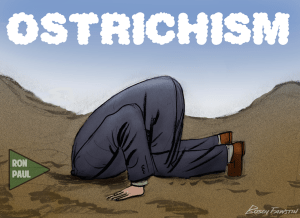
So, what term would encompass Ron Paul’s distinctive — and distinctively wrong — foreign policy positions? The only term I could come up with so far was the metaphorical term, “ostrichism.” The OED defines it as, “The policy of hiding the head like an ostrich.” On this web page it is defined as “A policy of burying one’s head in the sand, i.e. ignoring the reality of a situation,” which explains the meaning of the metaphor. This terms is an appropriate one to describe Ron Paul’s foreign policy, because there seem to be so many realities of our foreign policy situation that he must be ignoring in order to advocate the particular positions he has. Some examples:
—Paul voted against the use of sanctions against Iran, who is currently developing its capacity to produce nuclear fuel and whose president said, in his most recent statement regarding Iran’s intentions, “If we do want to make a bomb, we are not afraid of anybody.”
—He said Israel should not stop the flow of weapons to Hamas because, after all, Hamas was democratically elected (even though it’s a terrorist organization).
—He rejects the idea of preemptive strikes.
—He wants to eliminate all foreign aid, even aid to important allies like Israel. (He said this during the South Carolina debate this year.)
—He would not have killed Osama bin Laden, despite the fact that the Pakistanis were no doubt hiding him, and that bin Laden was apparently still active in directing Al-Qaeda in its terrorist plots against the United States and its allies.
—He is reported to have said, shortly after 9/11, that the threat from Jihadists “was a made up one,” and that “if we simply learned to leave them alone, they would in turn leave us alone.”
Besides the fact that there is a list of realities that Ron Paul seems to be ignoring, the picture of him, with his head buried in the sand, waiting for the first strike from our enemies, just seems so perfect! (Thanks, by the way, to Bosch Fawstin, for creating the above cartoon for me.)
Still, I know that ostrichism probably isn’t the right term, either. It can apply to any number of people ignoring any of numerous realities about a variety of situations. The term seems to have little, if any, connotation that would uniquely indicate a foreign policy position. In fact, when I Googled the term along with Paul’s name, I found some references in which Paul’s supporters applied the term to those who thought his popularity was a thing of the past.
But there’s one more definition that I found. The site that I linked to, above, also offers this as a possible definition: “Conduct like that of the ostrich: alluding to its habit of considering itself wholly concealed when only its head is hidden.”
Hmm, “consider[s] itself wholly concealed when only its head is hidden.” When do ostriches hide? Most likely when they believe they face a threat. So, perhaps we can sum up a foreign policy of ostrichism as: “Believing one is safe in the face of a potential threat, even though all one has done is chosen to ignore certain realities of the situation giving rise to that threat.”
What do you think? Any other suggestions?



 Don't Let It Go