Category Archives: Uncategorized

Ostrichism?

In this comment to this post, a commenter named Daniel pointed out that “isolationism” is an invalid concept. (See here.)

I had forgotten that reference, so thanks to Daniel for mentioning it. When writing that blog post I considered using the term Ron Paul uses, “non-interventionism.” But that term seems to me not to encompass some of his important foreign policy positions — e.g., his objection to the use of trade embargoes or sanctions, as well as his objection to aiding an ally in a way that falls short of “intervening”.

So, what term would encompass Ron Paul’s distinctive — and distinctively wrong — foreign policy positions? The only term I could come up with so far was the metaphorical term, “ostrichism.” The OED defines it as, “The policy of hiding the head like an ostrich.” On this web page it is defined as “A policy of burying one’s head in the sand, i.e. ignoring the reality of a situation,” which explains the meaning of the metaphor. This terms is an appropriate one to describe Ron Paul’s foreign policy, because there seem to be so many realities of our foreign policy situation that he must be ignoring in order to advocate the particular positions he has. Some examples:

—Paul voted against the use of sanctions against Iran, who is currently developing its capacity to produce nuclear fuel and whose president said, in his most recent statement regarding Iran’s intentions, “If we do want to make a bomb, we are not afraid of anybody.”

He said Israel should not stop the flow of weapons to Hamas because, after all, Hamas was democratically elected (even though it’s a terrorist organization).

—He rejects the idea of preemptive strikes.

—He wants to eliminate all foreign aid, even aid to important allies like Israel. (He said this during the South Carolina debate this year.)

—He would not have killed Osama bin Laden, despite the fact that the Pakistanis were no doubt hiding him, and that bin Laden was apparently still active in directing Al-Qaeda in its terrorist plots against the United States and its allies.

—He is reported to have said, shortly after 9/11, that the threat from Jihadists “was a made up one,” and that “if we simply learned to leave them alone, they would in turn leave us alone.”

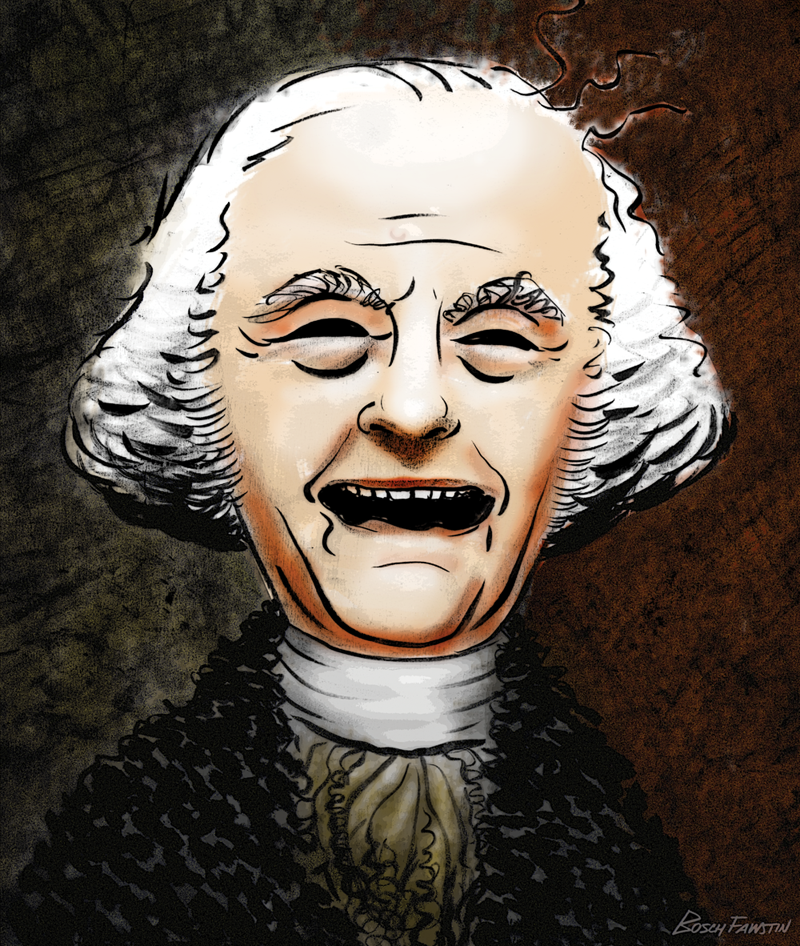
Besides the fact that there is a list of realities that Ron Paul seems to be ignoring, the picture of him, with his head buried in the sand, waiting for the first strike from our enemies, just seems so perfect! (Thanks, by the way, to Bosch Fawstin, for creating the above cartoon for me.)

Still, I know that ostrichism probably isn’t the right term, either. It can apply to any number of people ignoring any of numerous realities about a variety of situations. The term seems to have little, if any, connotation that would uniquely indicate a foreign policy position. In fact, when I Googled the term along with Paul’s name, I found some references in which Paul’s supporters applied the term to those who thought his popularity was a thing of the past.

But there’s one more definition that I found. The site that I linked to, above, also offers this as a possible definition: “Conduct like that of the ostrich: alluding to its habit of considering itself wholly concealed when only its head is hidden.”

Hmm, “consider[s] itself wholly concealed when only its head is hidden.” When do ostriches hide? Most likely when they believe they face a threat. So, perhaps we can sum up a foreign policy of ostrichism as: “Believing one is safe in the face of a potential threat, even though all one has done is chosen to ignore certain realities of the situation giving rise to that threat.”

What do you think? Any other suggestions?

20 Comments

Filed under Uncategorized

Some Good News: Geert Wilders Acquitted


Geert Wilders, the leader of the Dutch Freedom Party who is known for criticizing Islam and, in particular, releasing the controversial film, Fitna, was acquitted by an Amsterdam District Court today. He had been charged with “inciting hatred and discrimination and insulting Muslims.”

As many, including Wilders, have already said, this is a tremendous victory for free speech in general, and for the fight against Islamization in particular. The verdict does not, however, erase the fact that Wilders has had to defend himself against this prosecution for two years. My hope is that Wilders was able to see his fight, in large part, as an opportunity to gain more publicity for his message (which it has done).

In addition, this verdict for Wilders in Amsterdam does not guarantee that others who are fighting Islamization, there or elsewhere, will be treated justly. For example, a police captain in Tulsa, Oklahoma, was recently suspended for refusing to attend a proselytizing event at an Islamic center. We have a long way to go yet.

Still, this verdict is cause for celebration.

5 Comments

Filed under Uncategorized

Originalism is Ron Paul’s Undoing. Will It Also Be Ours?

Last week Ron Paul won yet another straw poll, this time at the Republican Leadership Conference in New Orleans. He is reported as having said, “I’ve never been as optimistic as now” about his chances of winning the Presidency in 2012. Early in May I explained in this blog post why I will not vote for him: I disagree with his isolationist foreign policy, including his refusal to support our important ally, Israel. I also disagree with his positions on abortion and education.

Some who have responded to my post have argued that Ron Paul’s isolationism is proper because that was the Founding Fathers’ position on foreign policy. Assuming that is true, while an isolationist foreign policy may have been proper in the context of the eighteenth century, today, in a world of ICBMs that might be carrying nukes, isolationism is not adequate for the protection of the United States. Isolationism vs. neoconservative nation-building is a false alternative. There is a proper foreign policy which consists of pursuing our national self-interest, a foreign policy that rejects isolationism on the one hand, and neoconservative nation-building on the other.

This week I read another critique of Ron Paul, one that helped me to identify the deeper error behind some of Paul’s political positions. David Kopel, in this post on The Volokh Conspiracy, observed that those politicians, including Paul, who have signed the “2012 Pro-Life Citizen’s Pledge” are actually pledging to appoint judges who would, because of their originalist leanings, overturn as unconstitutional the very anti-abortion legislation they were pledging to advance and sign into law. Kopel was disappointed by this, because Paul had seemed to him to be “scrupulous” about his originalism in the past. The example Kopel gave was that of Paul, who supports the right to own a gun, nonetheless voting against the Protection of Lawful Commerce in Arms Act on the grounds that “the law exceeded the federal power to regulate interstate commerce.”

I am not an originalist, so whether Paul scrupulously adheres to originalism is not important to me. It is, of course, disappointing when a politician appears to be compromising or abandoning his methodological principles in order to further a particlar substantive position. At the very least, something like this makes one wonder whether he can count on or predict that politician’s behavior at all. But here I don’t necessarily see the issue as Paul abandoning or contradicting an originalist position. Rather, I see both Paul’s action here, and his embracing of an isolationist foreign policy, as illustrations of the problems inherent in originalism itself.

In her article, Why Originalism Won’t Die – Common Mistakes in Competing Theories of Judicial Interpretation, Tara Smith explains that, while originalism seems to promise objectivity in the realm of Constitutional interpretation, this is an illusion. She identifies the most seemingly objective version of originalism – the “authors’ criteria view” – that we might fairly ascribe to Paul. On this view, “the concepts employed in our laws refer to what the law’s authors meant by the concepts in question, that is, what they took to be ‘cruel,’ ‘equal protection,’ etc.—rightly or wrongly.”

Paul, using this type of originalism, might argue that his two ostensibly contradictory positions on the commerce clause – one, his vote against the Protection of Lawful Commerce in Arms Act, the other his pledge to advance and sign into law a Pain-Capable Unborn Child Protection Act – can be reconciled. He could argue that, while the former did not fall within the criteria actually held by the Constitution’s Framers (the authors of the commerce clause), the latter does. (I leave it as an exercise for any lawyers who might be reading this to figure out the plausible arguments to be made here.) True, the authors of the commerce clause may have had wrong or self-contradictory criteria for determining what can be regulated pursuant to the commerce clause. In fact, I think the confusion about the commerce clause during the centuries since our country’s founding is testament to that. But, the originalist says, come hell or high water, it is the Framers’ criteria that we should apply.*

Similarly, while the Founding Fathers may have wrongly set isolationism, rather than an objectively identified national self-interest, as the criteria for a proper U.S. foreign policy, the originalist will insist that we adhere to whatever the Founders’ criteria happened to be. Hence Ron Paul’s rejection not only of nation-building, or of “exporting” democracy at gun-point, which I think he is right in rejecting, but also his categorical rejections of pre-emptive strikes, foreign aid, and trade embargoes (these last, he says, amount to acts of war).

I am not saying that Originalism will explain all of Paul’s errors. For example, there is very little real argument on his website in support of his anti-abortion stance, and this is a position I find untenable for reasons stated here. He also has taken the side of Hamas over Israel and is known to have associated with and tolerated conspiracy theorists and holocaust deniers.

I understand the appeal of Ron Paul to Tea Partiers and others who realize the immorality and danger of a government that grows ever bigger and more intrusive, and that spends well beyond its means. Paul seems to be the candidate who has the longest track record of supporting the drastic spending cuts and radical reforms in monetary policy that are necessary to get us back on the right track. And yes, these, too, are likely a product of Paul’s originalism. What we need, however, is not a candidate who accepts wholesale whatever our Founders, as great as they were, meant when they wrote and established the Constitution. Rather, we need a candidate who understands what policies are right for the United States – those that protect individual rights – and who will work either within the scope of the Constitution or, as might sometimes be necessary, to change the Constitution, in order to implement them.

*Note that, in addition to originalism committing one to sometimes applying incorrect or self-contradictory criteria, it also has the problem of sometimes forcing one to choose from among several conflicting but reasonable inferences as to what those criteria actually were, as well as their proper application to entities and events in today’s world.

[Update: After reading this post by Randy Barnett, I wonder whether the version of Originalism to which Ron Paul subscribes is nothing more sophisticated than what Barnett calls “channeling the framers” — i.e., trying to determine how the framers themselves would have applied the meaning of the Constitution’s language (determined via the “authors’ criteria”) to particular cases. I refer you to Barnett’s post also because he discusses, and includes a link to, the latest contribution to the Originalist literature, a paper by Larry Solum.

Also, if you’re interested in reading Tara Smith’s critique of more sophisticated versions of Originalism, including Barnett’s, you can find it here.]

18 Comments

Filed under Uncategorized