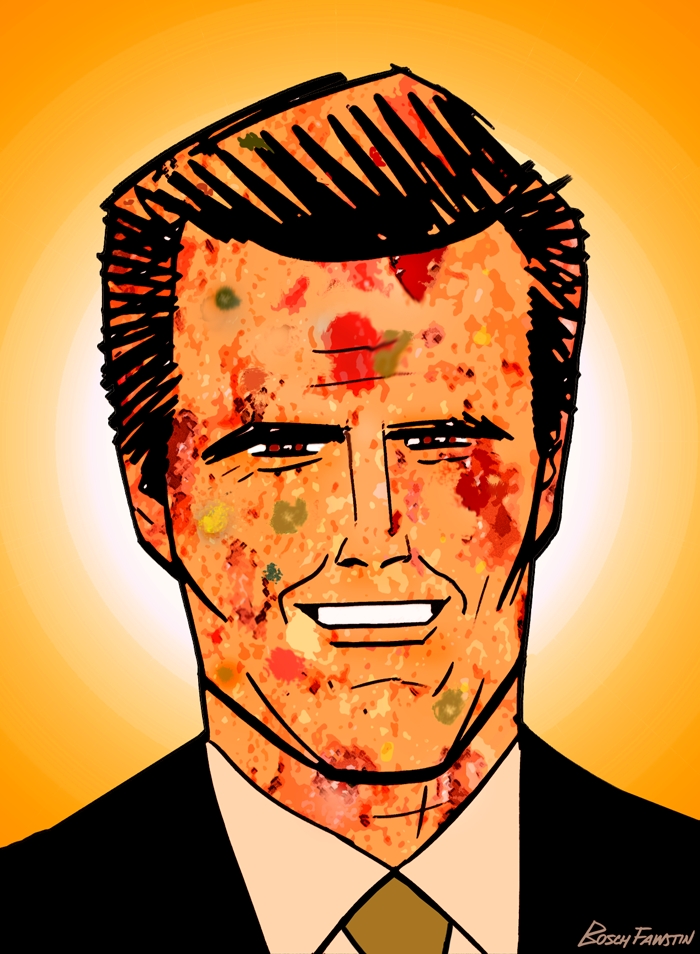
Like the oft-gifted holiday food item, that few people admit to actually liking, Romney is the candidate whom few actually like, but whom everyone assumes everyone else will vote for.
I haven’t yet decided which candidate I will support in the Republican primaries. Johnson, with whom I agree on most issues, is somewhat weak on foreign policy and, in his remarks on the President’s decision to send troops into Uganda, did not consistently apply the “military threat” principle he had applied in discussions of Iran and Libya. Cain, whom I like on many issues, seems to be working quickly to get up to speed on some issues, and may be modifying his positions on others, particularly social issues. So it’s too soon to tell.
Of course it is important to keep in mind the context here: I do not expect that I will be able to vote for my ideal candidate in the 2012 elections. I am merely looking for a candidate whom I can like or respect to some extent, who will stop the bleeding both in terms of our economy and our foreign policy, who won’t try to impose his religious views, and who won’t further damage the reputation of capitalism and the free market. Is that too much to ask?
In a previous blog post, I explained why I don’t think Ron Paul satisfies my criteria with respect to religion and foreign policy. And Yaron Brook, when interviewed on my podcast, explained why he thinks Paul might damage the reputation of capitalism and the free market: he does not consistently apply the principle of individual rights.
In the first hour of Sunday’s podcast, I took a closer look at the presumptive favorite in this race: Mitt Romney. In the days leading up to the show, I came up with various puns: “Mutt Romney”, because he’s a “mixed breed” candidate who isn’t quite liberal or conservative, Democrat or Republican. “Mint Romney”, because, just as a breath mint can only mask bad breath temporarily, neither Romney’s slick demeanor nor his coiffed hair can cover the stench of his stale, socialist-leaning policies. “Mitt Rob Me” because that’s what he plans to do — to all of us. Etc.
But my favorite label for him is one that I came up with during the podcast: that Mitt Romney is the fruitcake of 2012 Presidential Candidates. Like the oft-gifted holiday food item, that few people admit to actually liking, Romney is the candidate whom few actually like, but whom everyone assumes everyone else will vote for. My question is: why is everyone assuming this? If I don’t like him, and I know I would not be happy voting for him, then why should I assume that everyone else will enjoy voting for him? As I explained in my podcast, our dislike of Romney is not for arbitrary or superficial reasons. If you go to his site and actually read his 59(!)-point plan (I read the 5-page executive summary, which is really all you need), you will see that his proposals are at best timid ($20 billion in cuts — please!) and, at worst, measures that will further entrench the welfare state. A little tinkering and protectionism here, a little shuffling of money from federal government to state government there, all packaged in such a way as to be passed off as a “sever[e] break…from our current course,” “fundamental change,” “deeply conservative,” “highly ambitious,” and, of course, based “on the principles of free enterprise, hard work, and innovation.”
So, why is it that one of the current leaders in this race is a candidate whom very few like, a candidate whom we have ample reason to dislike? Why do we assume that he is “electable” — which means, if it means anything, that we are assuming that other people will like and vote for him? Thoughts?
[Thanks to Bosch Fawstin for the perfect graphic!]


 Don't Let It Go